FALCONRY AS A BIODIVERSITY CONSERVATION TOOL By Janusz Pawel Sielicki
Publication at: https://www.researchgate.net/publication/312214068
Abstract
Falconry is one of oldest human activities, goes back thousands of years.
It is defined as ‘taking quarry in its natural state and habitat by means of trained birds of prey’. It was for centuries using wild birds of prey. Falconry is sustainable, as the numbers of birds used are small comparing to the natural mortality rates. Protection of nests of birds of prey were amongst the oldest conservation laws in Europe.
Falconry techniques are widely used in conservation and rehabilitation of birds of prey.they have proved through millennia to be effective in taming
birds and to keep them healthy and in good condition. Falconers were the first to notice the decline of Peregrine numbers in Britain and in other countries. They also started the studies to unveil the reasons for this decline. As a result DDT was banned and birds of prey populations started to grow. Falconers learned how to intensively breed Peregrines, the methods used later for many other birds of prey species. Large projects for the breeding and reintroduction of Peregrines were started by falconers in the USA, Canada, Germany, later also in Poland. Falconry techniques were used even in the countries where falconry was not practiced, like Sweden. Reintroduction was the only way to recover Peregrines in areas where they we extinct. Falconers in the USA organised a largest birds of prey protection organisation in the world
– The Peregrine Fund
Large crisis in vultures of Asia was also unveiled in 2004 thanks to projects financed by TPF. The reason for the catastrophic decline of vulture populations was diclofenac. Its effect was disorder of the kidneys and rapid death, effecting in decline of even 99% by 2008. Falconers are working to restore vulture populations by breeding and reintroduction projects. Currently we see a large decline in Saker Falcon in Asia. Large studies undertaken in Mongolia by falconers have proved that at least 5 thousand Sakers are killed annually by electrocution on mid-voltage lines. Falconers involved in conservation of huntable species. One of first large scale programmes by falconers was the establishing of the North American Grouse Partnership in 1999. The aim of this organisation is the protection of the habitats of the North American grouse species and their sustainable use. The latest initiative of IAF is a Perdix portal, aimed at conservation of habitats of European partidge, sharing knowledge on their management and best cases of sustainable use.
Falconry is inscribed on UNESCO Representative List of the Intangible Cultural Heritage of Humanity. Falconry today is not only hunting, but also conservation, culture and education.
Key Words: falconry, biodiversity, sustainable use, cultural heritage
Introduction
We cannot be sure exactly how old falconry is because a significant problem with recorded history is that history can only be recorded where records exist. The earliest written records found describe a highly organised and technical falconry that must have taken many hundreds, if not thousands of years, to evolve to that level of sophistication. There are artefacts depicting falconry which are at least 4,000 years old and such date was used in the UNESCO submission (UNESCO 2016).
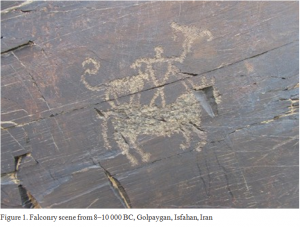
There are some petroglyphs in Golpaygan, Isfahan, Iran, depicting a horseback hunter with a bird, which could be a falcon, and a cheetah or saluki- like sighthound. They can be dated as far as ca. 8000–10 000 B.C., what means that falconry is even older. For at least 10 000 years of sustainable falconry falconers have been using wild hawks, falcons and eagles, sometimes in very large numbers, as in the time of Chinggis and Kublai Khan whose hunting campaigns included as many as 5000 falcons.
Falconry and conservation
Protection of nests of birds of prey used for falconry were amongst the first laws of nature protection. Falcons belonged to the rulers, together with large ungulates. Such laws in medieval Europe named falcatio obliged peasants to protect falcon nests. If they failed they were obliged to pay a significant penalty (Mizera, Sielicki 2009). Falconers mostly use first few month old birds. These are easier to train. Immature birds in nature survive at circa 20–30% rates in their first year (Newton 1979). Usage of young birds in falconry is sustainable and does not affect their populations, being outnumbered by natural mortality. Birds of prey used in falconry are traditionally released after the hunting season in some cultures or kept for many years in other traditions. Both minimise any effects of falconry on the wild populations.
Falconry techniques are widely used in conservation and rehabilitation of birds of prey. Through millenia they have proved to be effective in taming birds and to keep them healthy and in good condition. Especially maintaining their plumage in good condition, which is crucial for the raptors In the mid-20th century falconers started to breed falcons. The first ever to breed a bird of prey was Renz Waller, a German falconer, in 1944 (Waller 1973). He was followed by Professor Tom Cade, an American falconer, who also started work the reintroducion of Peregrines (Weaver, Cade 1991). In Europe the first to breed and release Peregrines was Prof. Christian Saar, another German falconer. Later in Poland breeding projects were started by Prof. Zygmunt Pielowski and Czesław Sielicki. Methods of intensive breeding, incubation of eggs and reintroduction of Peregrines were later adapted to other species of birds of prey.
That work came at just the right moment. In the 1960’s there began an unprecedented crisis in birds of prey populations, especially in the large falcons. The reason was a widespread usage of new pesticides of the organochlorine group, especially DDT. DDT and its derivatives accumulated in the food chain. A long term effect of DDT on falcons was the deregulation of their calcium economy resulting in the thinning of eggshells. Eggs were crushed under incubating females. This resulted in dramatic declines of Peregrine populations worldwide and the extinction of this species in many areas of the world, in most of Europe, including central Europe and most of North America. Decline was also observed in many other species of birds of prey (Hickey ed. 1969).
Falconers were the first to notice the decline of Peregrine numbers in Britain and in other countries. They also started the research to unveil the reasons for this decline. A ban on DDT was enforced in the early 1970’s and some populations slowly recovered. Large projects for the breeding and reintroduction of Peregrines were started by falconers in the USA, Canada, Germany, later also in Poland. Falconry techniques were used for these projects, even in countries where falconry was not practiced, like Sweden (Sielicki, Mizera 2009).
Falconers in the USA organised a largest birds of prey protection organisation in the world – The Peregrine Fund. Since than many projects on all continents have been financed by this organisation. One of these projects is California condor rescue, conducted together with other organisations, including the San Diego Zoo. In the mid-1980s the last 8 wild condors were captured and put into a breeding project which also included all captive birds from zoos. Only 22 California Condors altogether were alive at that time. Now more than 400 Condors are in captivity and living free in several areas of the South-West USA (BirdLife 2015). Many other projects on birds of prey conservation have been conducted or are ongoing in the Americas, Africa and Asia. The last mysterious crisis in vultures of Asia was also unveiled in 2004 thanks to projects financed by The Peregrine Fund. The reason for the catastrophic decline of vulture populations was diclofenac, a nonsteroidal anti-inflammatory drug widely used in human and animal medicine. Its effect was disorder of the kidneys and rapid death. The decline was recorded as 99% by 2008 (BirdLife 2008). Again falconers are working to help the vulture population to restore by breeding and reintroduction projects.
Currently we see a large decline in another species – the Saker Falcon in Asia. Again falconers are working to find out the reasons for the decline. Large studies undertaken in Mongolia have proved that at least 5 thousand Sakers are killed annually by electrocution on mid-voltage lines (Dixon et al 2013). The International Association for Falconry and Conservation of Birds of Prey together with its partners have been actively looking for possible funders of the mitigation works necessary on the most dangerous lines in Mongolia. A first step has been taken by the Qatari government, which has offered to finance mitigation works on 1000 kilometres of the electric lines most dangerous for Saker falcons. The aim for next few years is to properly maintain the dangerous lines in the other countries of the Saker’s range, including migration routes and wintering areas.
A Saker management project is currently being carried out in Mongolia. 5000 artificial nests are to be built in the steppe, where there are no natural nest sites for the Saker. In 2014 almost 800 nests were actively producing more than 3000 chicks. In exchange for that up to 300 licences for trapping wild Sakers are issued in Mongolia (MEFRG 2016). This is an example of a sustainable use project. An additional project connected to the artificial nests project is the School Link Programme, aimed at promotion of knowledge of sakers and birds of prey and their conservation.
The Polish Peregrine Project started in the 1980s with breeding centres in Czempin and Wloclawek. The first reintroductions started in 1990 and the first breeding attempt was in Warsaw in 1998, with the first success a year later in Wloclawek and Torun. The main aim of this project, bringing back Peregrines to Polish fauna was achieved. In subsequent years reintroductions were continued and at the end of the first decade of the 21st century there were circa 20 pairs of Peregrines in Polish cities and mountains (Sielicki, Sielicki 2009).
In 2010 a new intensive project of reintroduction of Peregrines in forests was started. Traditionally Peregrines in Central Europe nested on trees. This ecotype was lost during the DDT crisis. In the Eastern part of Germany a similar project on restitution of tree nesting Peregrines was started in 1990 and resulted in circa 20 pairs in 2010 (Kleinstauber 2010) and more than 50 in 2015 (Kirmse inlitt.). The Polish intensive reintroduction project is run by Society for Wild Animals “Falcon”. Since 2010 a total of almost 600 Peregrines have been released in Polish forests, in 4 releasing sites. In 2013 the first nest in a forest was confirmed in Barlinek forests (NW Poland), near the release site. In 2014 a first nest in Mazury region was found in the reintroduction box, being the result of a 3 year release project in this area. In 2015 we have already 5 nests of Peregrines in forests, all near the release sites. An important part of the project is a wide awareness campaign among the foresters. Each forestry in Poland has a brochure and poster on Peregrines and in areas close to the release sites 2-hours courses for foresters were arranged. A special prize for those who find the new nests of tree-nesting Peregrines is high quality optics.
Falconry and quarry species
The ancient art of falconry, a hunting tradition, is defined as ‘taking quarry in its natural state and habitat by means of trained birds of prey’. Falconers are deeply involved in conservation of birds of prey, but also huntable species are of our interest. One of first large scale programmes by falconers was the establishing of the North American Grouse Partnership in 1999. The aim of this organisation is the protection of the habitats of the North American grouse species and their sustainable use. The latest initiative of IAF (International Association for Falconry and Conservation of Birds of Prey) is a Perdix portal. Similar to the American project it is aimed at conservation of habitats of European partidge, sharing knowledge on their management and best cases of sustainable use. Falconers promote sustainable use on a daily basis. The Scottish moors are one of the examples, where most of them are aimed at shooters, but those which are less productive are run for falconry use. That does have economical value, but more important are the landscape and biodiversity conservation effects.
Falconry and UNESCO
UNESCO’s Intangible Cultural Heritage of Mankind is another international convention, less well known than the UNESCO World Heritage Sites. The inscribed traditions first are on national lists and then can be proposed for the Global Intangible Heritage List. Those which are practiced in more than one country can be proposed by few countries together. Intangible Cultural Heritage is transmitted from generation to generation, recreated by communities and groups in response to their environment, their interaction with nature and the historical conditions of their existence. It provides people with a sense of identity and continuity, and its safeguarding promotes and develops cultural diversity and human creativity.
So the Intangible Cultural Heritage insists that the elements must be passed from parents to children, from tribal leaders to youth. These elements cannot be learned entirely from books or videos. Passing the element down the generations means that artificial boundaries, like languages, lines on maps, political or religious divisions or ethnic considerations, are all transcended. This happens when the cultural element defines the community. This is why many falconers feel more at home thousands of kilometres from where they live, than they do in their nearby cities.
Falconry fits into every aspect, every rule and every guideline that UNESCO has written into the protocols for acceptance on its lists. It is practiced in many countries, so the solution was to prepare inscription representing countries of different regions. Those countries had to first inscribe falconry on their national heritage lists. Poland was represented at the first workshop preparing the falconry inscription, but unfortunately we could not proceed, as the Convention was not ratified by Poland at that moment. Finally a first inscription file representing falconers from 11 countries was submitted and in 2010 UNESCO welcomed falconry as an element on the Representative List of the Intangible Cultural Heritage of Humanity (UNESCO 2016). Falconry is still the largest multi-national element – originally 11 countries, later 2 more were added and now another group of 3 of countries are following.
It is also acknowledged as the best presented application ever received by UNESCO and the file is used as an example to applications for other cultural inscriptions: “If you do it like the falconers did it, you will probably succeed. It was the falconers of the world that achieved the inscription, even the falconers of countries whose governments are not even signatories to UNESCO Intangible Cultural Heritage, like the UK, Ireland and the USA. People from all these countries worked on the dossier”. Falconry in Poland was proposed to be inscribed into the national heritage list this September by Mr Janusz Sielicki, the representative who is formally responsible for that process. The proposal was accepted by the National Heritage Council on October 7th. Now it is waiting for the final decision of Polish Minister of Culture. Once inscribed on the national list, preparations will start to add Poland to the international UNESCO Heritage list.
The Tripod, how falconers support themselves
Falconry is hunting with a trained bird of prey, an eagle, a falcon or a hawk. Falconers are few, maybe less than 100,000 people in a world of 7 billion. For every one falconer there are some 70,000 people who are not one. Falconers are, in every country, a minority. Many of greater majority do not understand hunting, nature and the environment. For many years falconers have suffered attacks at national and international levels from people who believe falconry to be a threat to the conservation of birds of prey and to nature in general. This is despite overwhelming evidence to the contrary.
Conservation
Conservation is one of the three legs of the tripod that supports falconry. Falconers are active conservationists and most falconry clubs and national organizations now have conservation projects that they are involved in or that they support actively. Falconers run numerous rehabilitation facilities around the world. Falconry community support legal and sustainable use of wild raptors and are against illegal use of wild populations of birds of prey.
Culture
The second leg to support falconry is Culture, whose significance is only really being understood since we embarked on the UNESCO project.
Falconry is an individualistic pursuit, falconers go out alone or in small groups and hunt in areas remote from the cities and population centres where most people live, so most people do not see falconry, something we have found out to our cost. If a nation’s people do not know about it, they can let it disappear. Once you have seen falconry you can only become a supporter of falconry, even aspire to becoming a falconer.
Education
The third leg of the tripod to support falconry is Education, in its many forms and faces, Youth, Animal Welfare, Veterinary Medicine, online education and an International Falconry Academy. IAF co-organized the first veterinary conference on specialised medicine and surgical procedures for falconry birds, raptors. This was in January 2015 in Doha, with the support of the Souk Waqif Falcon Hospital. Over the next two years we will be involved in two more veterinary workshops and conferences, one aimed at student vets wishing to specialize in this field. The second will be a conference for research scientists to present new work in the field of raptor veterinary medicine.
All this means that veterinary medicine for birds of prey, particularly research, is led by falconers who fund research in USA, as well as the falcon hospitals in the Gulf that allow research and practice on birds of prey to develop. Falconers were leaders in studies on avian flu, West Nile virus, DDT and diclofenac effects and many more.
Education works both ways, elders educate the youth and the youth educates their fathers. The meteoric rise of the internet and social media has done much good, we are no longer alone in the desert. Technology has put us in touch with genuine falconers in faraway places that we could never have known about before.
A country that uses this tripod to support its falconry – hunting, conservation and education will always have a strong falconry.
The future of falconry
IAF is communication and it can best advise by communicating the problems discovered in other countries to those who might suffer from the same problems in the future. Preserving what we have is important. In Europe we have an estimated 15,000 falconers, this is in one of the most densely populated regions of the world where changing agriculture, intensification, and the growth of cities has reduced the amount of game species and numbers to an alarmingly low number. Falconers are now finding it more and more difficult to find quarry to hunt. Hunting territories have become very expensive to rent. The speed that species are becoming extinct or disappearing from their original habitats is accelerating.
Summary
Falconers are actively working for biodiversity towards the conservation of farmland birds, not ignoring the circumstances that are causing it. Falconry is hunting game in its natural habitat with a trained bird of prey; without game there is no falconry. There are fewer and fewer areas in Europe for hunting species like the grey partridge, found in huge numbers across central Europe up until the 1970s. In parts of Europe the partridge has become totally extinct. Not only game species are affected, farmland birds like larks, buntings, lapwings, curlew, even sparrows are declining at alarming rates. The reasons for the decreases are well known and have been sufficiently studied: fast changing agricultural methods, loss of different elements of the original countryside, raising mono-cultures, harvesting crops during the night and in early spring and the use of synthetic pesticides. The absence of insects that these have caused makes the survival of species farmland birds, like partridge, lark and lapwing, nearly impossible.
Falconers and hunters are aware of the situation and great efforts are being made by them in areas where falconry and hunting is practiced to encourage the biodiversity necessary to encourage all these birds. Falconers admitted their responsibility for the environment on United Nations International Day for Biological Diversity – 22 May, when the International Association for Falconry and Conservation of Birds of Prey, acting on an initiative of the DFO (German Falconers Association), established a working group for European Biodiversity consisting of falconers and hunters with scientific and practical background to raise awareness and to seek solutions, called the Perdix Portal Working Group.
References
BirdLire International 2008. Threatened Birds of the World. Cambridge, UK: BirdLife International.
BirdLire International 2015. Gymnogyps californianus. The IUCN Red List of Threatened Species 2015.
Dixon A., Maming R., Gunga A., Purev-Ochir G., Batbayar N. 2013. The problem of raptor electrocution in Asia: Case studies from Mongolia and China. Bird Conservation International (2013) 23:520–529.
Hickev J.J. (ed.) 1969. Peregrine Falcon populations: their biology and decline. University of Wisconsin Press, Madison, WI.
Kleinstauber ed. 2010. Die Rückkehr des Wanderfalken in die großen Wälder, Arbeitskreis Wanderfalkenschutz e.V.
Merrc 2016. http://www.mefrg.org/manp.asp
Mizera T., Sielicki J. 2009. Breeding status of the Peregrine Falcon in Poland during the pre- and post- DDT era. In: Sielicki J. i Mizera T. (eds.). Peregrine Falcon Populations – status and perspectives in the 21st Century. Turul – Poznan University of Life Sciences Press, Warsaw–Poznan.: 153–168.
Newton I. 1979. Population ecology of raptors. T. & A.D. Poyser, Berkhamsted, UK.
Sielicki J., Mizera T. (eds.) 2009. Peregrine Falcon Populations – status and perspectives in the 21st Century. Turul – Poznan University of Life Sciences Press, Warsaw–Poznan Sielicki S., Sielicki J. 2009. Restoration of Peregrine Falcon in Poland 1989–2007.
In: Sielicki J. i Mizera T. (eds.). Peregrine Falcon Populations – status and perspectives in the 21st Century. Turul – Poznan University of Life Sciences Press, Warsaw–Poznan.: 699–722.
UNESCO 2016. http://www.unesco.org/culture/ich/en/RL/falconry-a-living-human- heritage-00732
Waller R. 1993. Der wilde Falk ist mein Gesell, Neumann-Neudamm Morschen/Heina.
Waller R. 1993. Der wilde Falk ist mein Gesell, Neumann-Neudamm Morschen/Heina.